

Overview
The Legislative Drafting Division (LDD) is headed by the Legal Draftsperson. This Division provides legislative drafting services to the Government in the formulation of new Bills, amendments to existing legislation and the drafting of other statutory instruments.
The Legislative Drafting Division of the Attorney-General’s Chambers consists of the following positions:
1. Legal Draftsperson;
2. Deputy Legal Draftsperson
3. Chief Legislative Drafting Counsel;
4. Principal Legislative Drafting Counsels;
5. Senior Legislative Drafting Counsels; and
6. Legislation Publication Officer.
7 Executive Personal Secretary to the Legal Draftsperson
Legislative Drafting counsels under the Legislative Drafting Division (LDD) of the Attorney-General’s Chambers are the primary legal professionals who are authorised to carry out the Attorney-General’s function of drafting and endorsing legislation that is suitable for Solomon Islands.
Objectives
The objectives of the Legislative Drafting Division are to:
- Produce legislation that meets the policy objectives of the Solomon Islands Government (“SIG”) in a legally effective way;
- Produce legislation that is written in language that is clear, consistent, precise, accurate, error free and as easy to understand as possible;
- Ensure the public has access to legislation.
Functions
The Legislative Drafting Division carries out the following legislative drafting functions of the Attorney-General:
1. To provide a legislative drafting service to the Government by:
- Drafting or vetting Bills proposed for introduction into Parliament, including subsidiary Legislation and statutory instruments;
- Explaining and advising on content and meaning of draft legislation and the process of drafting legislation;
- Appearing before the Bills and Legislation Committee;
- Drafting amendments of Bills to be considered by the Committee of the Whole House;
- Maintaining impartiality within Government;
- Maintaining confidentiality;
- Advising at an early stage whether legislation is necessary to give effect to a policy change and, if so, the nature of the legislation required.
2. To maintain the statute book of Solomon Islands and provide access to legislation by:
- The printing and publishing of Bills, Acts and Subsidiary Legislation;
- The publication of Acts, Subsidiary Legislation and indexes to legislation Gazettes on the Attorney-General’s Chambers Official Website;
- Maintain an ongoing legislation digitalization, consolidation, reprint and publication program under the Legislation Act 2023.
Legislative Drafting
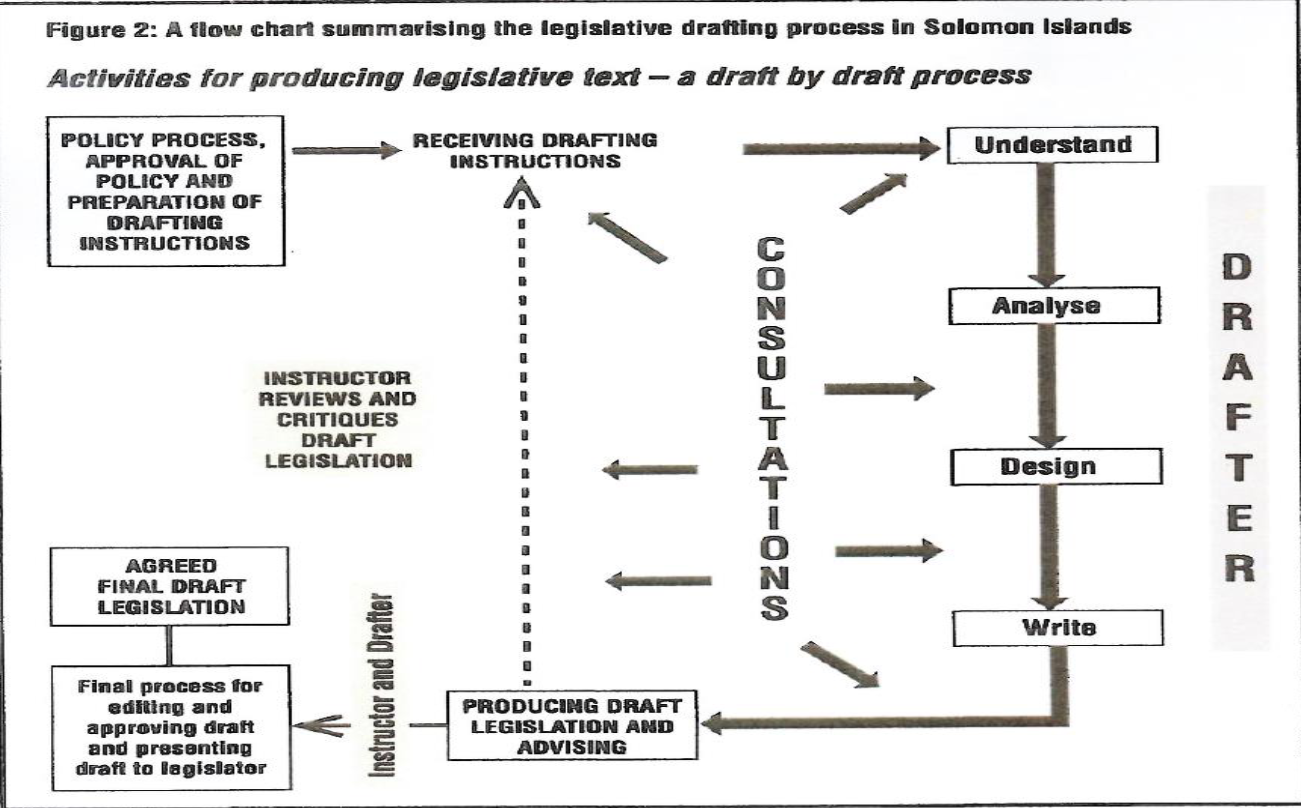
Drafting legislation is a specialist legal practice – it is not a mechanical exercise of putting policy ideas into a written legal format. It requires the ability to:
- Critically analyses a policy proposal for legislation to ensure that the proposal will be effective in practice;
- Express complex ideas in language that is clear, is not open to misinterpretation, is easy to understand and implement and avoids litigation and amendment;
- Design legislative schemes and compose appropriate legislative provisions that operationalize the policy proposal as an effective law.
An important part of this role is ascertaining if there are any deficiencies in the operation of the policy proposal as law, and putting forward alternative approaches to address the issues identified.
It also requires a goods general legal knowledge and particular knowledge of:
- Constitutional law, administrative law, statutory interpretation;
- The Interpretation and General Provision Act;
- The areas of Government business and associated government policies.
Each legislative drafting counsel aims to produce legislation that works well for Solomon Islands and has the following characteristics:
Clarity – Legislation that is written plainly, is logical and well-structured and is understood by Solomon Islanders;
Certainty – legislation that can only be interpreted in one way (and avoids litigation);
Applicability – legislation that applies to circumstances of Solomon Islands;
Flexibility – legislation that is capable of applying to multiple relevant situations, existing and future;
Durability – legislation that will last over time and will not need frequent amendment;
Accessibility – legislation that is easy to find.